

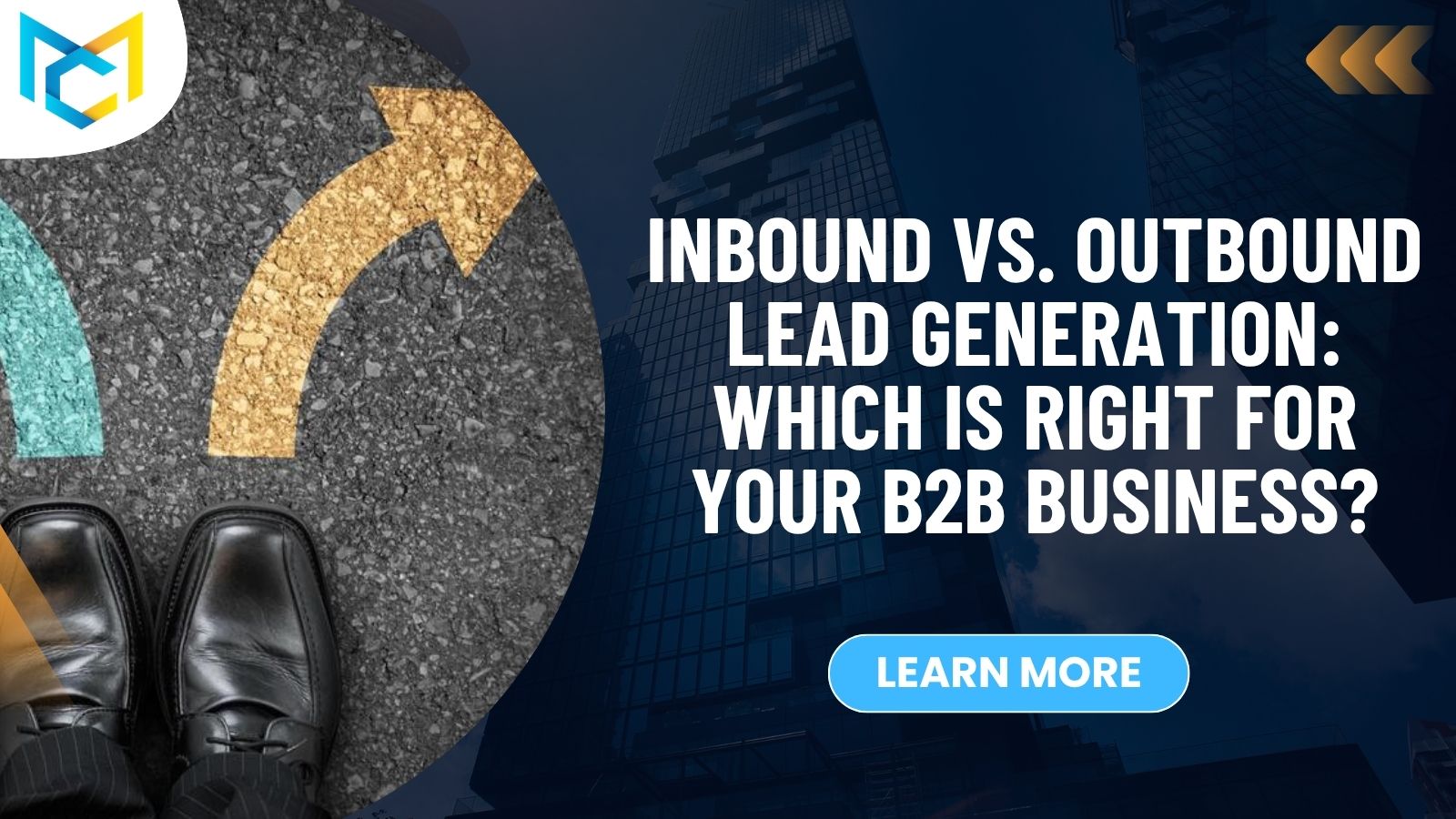
Every B2B company needs a consistent flow of qualified leads. The question that divides marketing and sales teams more than almost any other is how to generate them: by making your company findable and pulling buyers toward you, or by identifying ideal prospects and reaching out to them directly.
Inbound and outbound are not competing philosophies — they are different tools that work best in different contexts, and the most effective B2B lead generation programmes usually incorporate both. But most businesses do not have unlimited resources, and choosing where to invest first matters enormously. This guide gives you the framework to make that decision intelligently.
Defining the Two Models
Inbound Lead Generation
Inbound lead generation attracts buyers to your business by making your company visible and valuable at the moments when buyers are actively seeking solutions. The primary mechanisms are SEO-optimised content, social media presence, paid search advertising, and email nurturing — all designed to ensure your company appears when ideal buyers are researching.
The defining characteristic of inbound is that the buyer initiates contact. They find your content, engage with your brand over time, and reach out when they are ready. This makes inbound leads generally warmer and more qualified at the point of first contact than outbound leads — but it also means inbound results take longer to materialise.
Outbound Lead Generation
Outbound lead generation identifies specific companies and individuals who match your ideal customer profile and initiates contact with them directly — through cold email, LinkedIn outreach, phone calls, direct mail, or paid advertising targeted at specific named accounts.
The defining characteristic of outbound is that the seller initiates contact. This gives you immediate control over who you reach and allows you to target your highest-value accounts with precision. The trade-off is that prospects are generally less warm at the point of first contact, conversion rates from initial outreach are lower, and the process requires sustained, high-quality execution to work.
How Each Model Performs Across Key Dimensions
| Dimension | Inbound | Outbound |
| Time to first results | 3–12 months (builds over time) | Days to weeks (results possible immediately) |
| Lead quality at first contact | High — buyer has demonstrated intent | Variable — prospect has not self-selected |
| Scalability | Scales well with content and SEO investment | Scales with budget and team capacity |
| Cost over time | Decreasing — content compounds in value | Steady or increasing — effort is ongoing |
| Control over targeting | Limited — relies on buyer finding you | High — you choose exactly who to reach |
| Brand building effect | Strong — builds authority and reputation | Minimal — focused on pipeline, not brand |
| Sales cycle impact | Long-term — nurtures buyers over months | Short-term — targets buyers ready to evaluate |
| Best for | Complex products, longer sales cycles | High-value targets, specific account lists |
The Case for Inbound: When It Is the Right Primary Investment
Inbound lead generation is the stronger primary investment in several specific circumstances:
Your Sales Cycle Is Long and Research-Driven
When your buyers spend months researching before they contact a vendor, inbound marketing allows you to be present and valuable throughout that entire research period. Every blog post that answers a question your buyer is asking builds familiarity and trust that accumulates over time. By the time an inbound lead contacts you, they often already regard you as an authority — making the sales conversation qualitatively different from a cold outbound approach.
Your Product Requires Education Before Purchase
If your offering solves a problem that buyers do not yet fully understand, or if your approach is significantly different from the way buyers are used to thinking about the category, inbound content is an efficient way to educate at scale. You are shaping the buyer’s thinking before the commercial conversation begins.
You Want Marketing Assets That Appreciate Over Time
A well-written, SEO-optimised blog post published today continues to generate traffic and leads for years. Paid advertising stops the moment you stop paying. Content marketing is the closest equivalent in marketing to a capital asset — and inbound programmes built around content compound in value in a way that outbound simply cannot.
Our content marketing service is specifically designed to build this inbound foundation — creating the content infrastructure that generates compounding organic reach and sustained lead flow over time.
The Case for Outbound: When It Is the Right Primary Investment
Outbound lead generation is the stronger primary investment in a different set of circumstances:
You Have a Precisely Defined, High-Value Target Account List
When you can name the specific companies — and ideally the specific individuals within them — who represent your best possible customers, outbound is uniquely powerful. No inbound strategy can guarantee you will appear in front of exactly those people at exactly the right moment. A targeted outbound sequence can.
You Need Results Now
Inbound takes time to build. For a business that needs pipeline in the next 30 to 90 days — a startup launching its first sales motion, a company recovering from a pipeline shortfall, or a business entering a new market — outbound is the faster path to initial conversations.
Your Deal Sizes Justify High-Touch Outreach
The economics of outbound only work when the revenue potential of each closed deal is significant enough to justify the cost of the outreach effort. For B2B companies selling high-value contracts — where a single win is worth tens of thousands of pounds or more — the investment in personalised, account-targeted outbound is easily justified.
You Sell to a Small, Identifiable Universe of Buyers
If your total addressable market is a defined, manageable list of organisations — a specific industry, a specific geography, a specific company size — outbound allows you to work through that list systematically, maintaining visibility with every decision-maker who could ever buy from you.
Our lead generation service builds both inbound and outbound systems — often in parallel — ensuring that our clients are not dependent on a single source of pipeline.
The Reality: Most B2B Companies Need Both
The framing of inbound versus outbound as competing choices is a useful analytical tool but a misleading strategic guide. The reality is that the vast majority of successful B2B businesses use both — just with different emphasis at different stages of growth, and with the two motions designed to reinforce each other rather than operate in isolation.
A practical integrated model looks like this:
- Outbound generates immediate pipeline by targeting high-value accounts with personalised outreach, creating the early conversations your business needs to survive and grow.
- Inbound builds the brand and authority that makes your outbound more effective — prospects who have read your content before they receive your outreach are significantly more likely to respond.
- Content nurtures prospects who expressed interest through outbound but are not yet ready to buy — keeping your brand present across the extended consideration period of a B2B sales cycle.
- SEO and paid search capture the buyers who are actively searching for solutions in your category — the highest-intent traffic that exists in your market.
The specific balance between these elements depends on your stage, your resources, and your market. A startup in its first year will invest more heavily in outbound and use inbound as a brand-building complement. A more established business with consistent revenue can afford the longer horizon of an inbound-first strategy. Most grow by shifting the balance over time — from outbound-primary to a genuinely integrated model.
Common Mistakes in Each Model
Inbound Mistakes
- Publishing without SEO strategy. Content that is not keyword-aligned generates no organic traffic. The educational value of a post is irrelevant if nobody can find it.
- Producing content that is too broad. Generic content attracts generic audiences. B2B inbound works when content is specific enough to be genuinely useful to a defined buyer in a defined context.
- No conversion infrastructure. Traffic without a capture mechanism — relevant CTAs, mid-funnel offers, email capture — generates awareness but not pipeline.
- Giving up before the compound effect kicks in. Inbound results are back-loaded. The businesses that abandon the programme at month three never see the returns that months six through eighteen deliver.
Outbound Mistakes
- Generic, broadcast outreach. Outbound works through relevance and personalisation. A template email sent to 5,000 contacts without personalisation is not outbound marketing — it is spam.
- Targeting the wrong accounts. Outbound efficiency depends entirely on the quality of your target list. Reaching companies that do not fit your ICP wastes resources and produces no pipeline.
- No follow-up sequence. The majority of outbound conversions happen after the third or fourth touchpoint. A single email with no follow-up is not an outbound strategy.
- No supporting content. Outbound prospect who receive a cold message and then visit your website to evaluate you need to find compelling, credible content. Without it, the outreach effort is undermined at the point of evaluation.
How to Decide Where to Start
If you are choosing a primary lead generation model for the first time, or reconsidering an existing approach that is underperforming, three questions guide the decision:
- How quickly do you need pipeline? If the answer is immediately, start with outbound while building inbound in parallel.
- How well-defined is your target account universe? The more specifically you can define your ideal buyer, the more effective outbound will be relative to inbound.
- What is your realistic marketing horizon? If you have the patience and the budget to invest in a programme that builds over twelve or more months, inbound will deliver higher long-term returns. If you need a faster payback, outbound delivers more predictably in the short term.
For most B2B companies, the honest answer to all three questions points toward a combined approach — which is how our lead generation service is structured, and how our broader outsourced marketing engagements are designed.
Conclusion
Inbound and outbound lead generation are not competing philosophies. They are complementary tools, each with distinct strengths, that work best when designed to reinforce each other. Inbound builds the authority and organic reach that makes outbound more effective. Outbound generates the immediate pipeline that gives inbound programmes the time they need to compound.
The businesses that grow most effectively are those that understand this dynamic clearly — investing in the right balance for their current stage, measuring both models honestly, and evolving the mix as their market position strengthens. Treating either model as a standalone solution is almost always a mistake. Treating both as a coordinated system is almost always the answer.
Want to Build a Lead Generation System That Works Across Both Inbound and Outbound?
Marketing Cognitive designs and operates B2B lead generation programmes that combine the long-term compounding value of inbound with the immediate pipeline impact of targeted outbound. If your current approach is producing inconsistent results, we can show you what a properly integrated system looks like for your specific market and stage.
→ Talk to Our Lead Generation Team
Explore how our content marketing service builds the inbound foundation, how advertising accelerates reach across both models, and how HubSpot implementation connects your lead generation activity to a CRM that tracks every touchpoint from first contact to close.