

Most B2B marketing programmes cast a wide net — publishing content, running campaigns, and hoping that qualified buyers find their way into the funnel. Account-based marketing takes the opposite approach. Instead of attracting whoever happens to arrive, ABM identifies the specific companies most likely to become high-value clients and builds marketing activity entirely around them.
For B2B companies with long sales cycles, large contract values, and a defined universe of ideal accounts, this shift in orientation changes everything. ABM is not a tactic — it is a fundamentally different way of thinking about the relationship between marketing and sales, between effort and return, and between reach and relevance.
This guide explains what account-based marketing is, how it works in practice, which companies benefit most from it, and how to build an ABM programme that actually generates results.
What Account-Based Marketing Actually Means
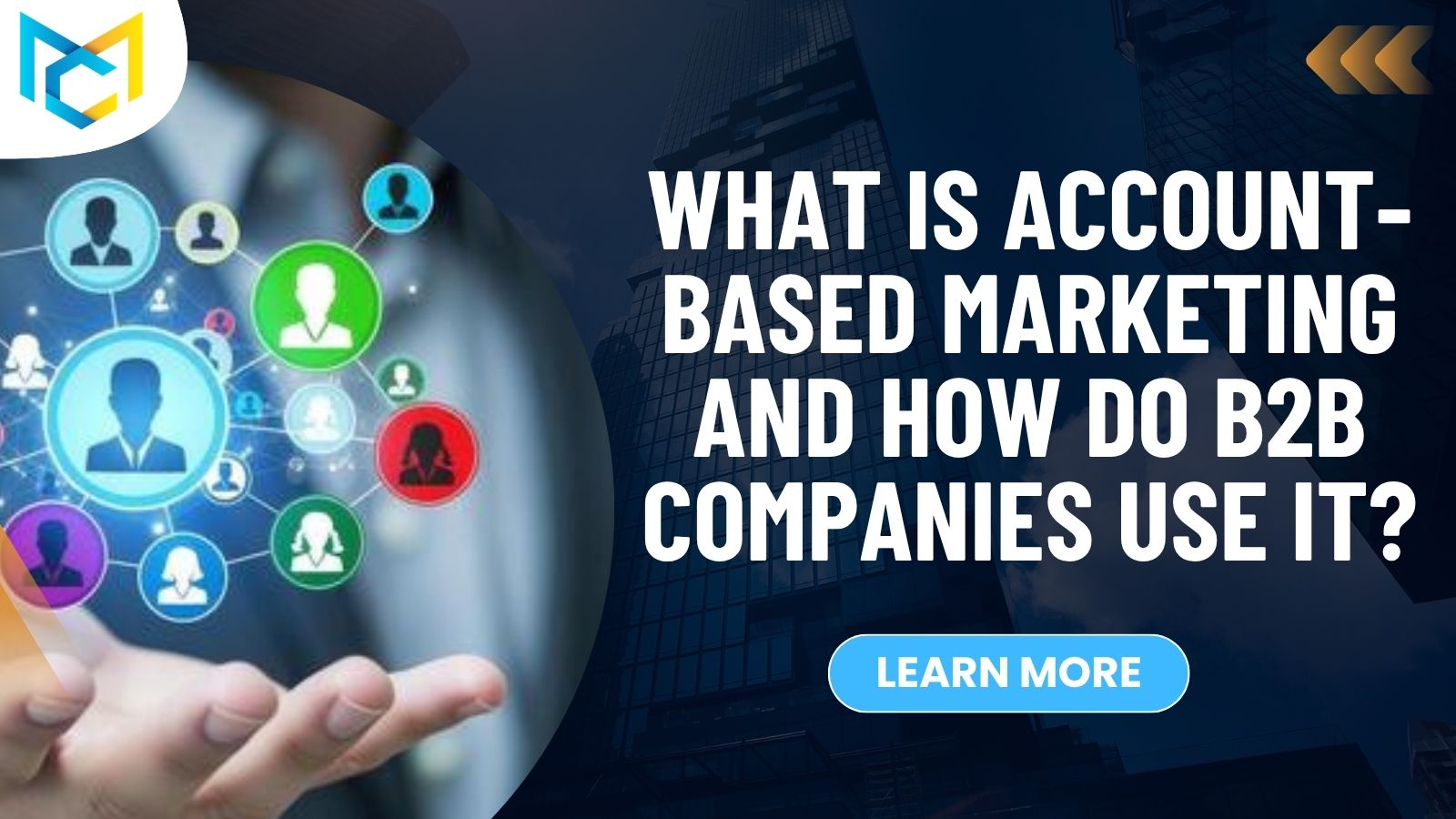
Account-based marketing is a B2B strategy in which marketing and sales teams collaborate to target a defined set of high-value accounts with coordinated, highly relevant content and outreach — rather than marketing broadly to an anonymous audience.
Instead of asking ‘how do we attract more leads from the market?’, ABM asks ‘which specific companies do we want as clients, and what do we need to do to win them?’. This reversal of the traditional funnel — from wide to narrow rather than narrow to wide — is what makes ABM distinctive and, for the right businesses, extraordinarily effective.
The logic is straightforward: if your best clients share specific characteristics — industry, size, business model, technology stack, growth stage — then there is a finite and identifiable universe of companies that look like them. Rather than spending marketing budget attracting everyone and filtering later, ABM invests that budget in creating relationships with exactly the right accounts before any commercial conversation begins.
The Difference Between ABM and Traditional B2B Marketing
| Dimension | Traditional B2B Marketing | Account-Based Marketing |
| Starting point | Define a broad audience, attract as many as possible | Define target accounts first, build everything around them |
| Content strategy | Educational content for general buyer personas | Personalised content for specific accounts and stakeholders |
| Sales alignment | Marketing hands over leads, sales follows up | Marketing and sales jointly own target accounts from the start |
| Success metrics | Volume — leads, traffic, MQLs | Engagement and pipeline within target accounts |
| Channel approach | Broad — SEO, social, email, events | Coordinated — every channel focused on the same accounts |
| Time horizon | Continuous — always attracting new leads | Campaign-based — sustained engagement with a defined list |
The Three Models of ABM
One-to-One ABM
The most intensive form of ABM — highly personalised campaigns built for individual, named accounts. Reserved for the highest-value potential clients where the revenue opportunity justifies the investment. Marketing materials, outreach, and engagement are built specifically for each company and adapted to the priorities, challenges, and stakeholder dynamics of that single account.
One-to-Few ABM
Campaigns built for small clusters of accounts that share meaningful common characteristics — the same industry, the same business challenge, or the same growth stage. Content and outreach are personalised to the cluster rather than the individual account, allowing ABM principles to be applied at manageable scale without sacrificing relevance.
One-to-Many ABM
Scaled ABM targeting a larger list of accounts — typically 100 to 1,000 — using technology and data to personalise content and targeting programmatically. Less intensive than the other models but more targeted than traditional demand generation. This is the most common entry point for B2B companies implementing ABM for the first time.
Which Companies Benefit Most From ABM
ABM is not the right strategy for every B2B business. It delivers its greatest return when several conditions are present:
- High average contract value. When a single closed deal is worth $50,000 or more, the investment in deeply personalised account engagement is easily justified. At lower deal values, the economics of ABM become harder to defend.
- A defined, finite universe of ideal accounts. If your best customers share specific characteristics that allow you to build a list of 50 to 5,000 companies that match your ICP, ABM gives you a way to systematically work through that list.
- Long, complex sales cycles. When buying decisions involve multiple stakeholders over months or years, ABM’s sustained, multi-touchpoint engagement is more effective than traditional lead generation at maintaining relevance across the entire cycle.
- Strong marketing-sales alignment. ABM fails when marketing and sales operate independently. The strategy depends on both functions sharing data, agreeing on target accounts, and coordinating engagement throughout the cycle.
- Products that solve specific, identifiable problems. The more precisely you can map your product’s value to a specific type of company’s specific challenge, the more relevant and effective your ABM content and outreach will be.
For companies that fit this profile — particularly B2B technology, professional services, and SaaS businesses — ABM consistently outperforms traditional demand generation on the metrics that matter most: pipeline size, deal value, and win rate.
How ABM Works in Practice
Stage 1 — Account Selection
The first step is building your target account list — identifying the specific companies that represent your highest-value opportunities. This is done by analysing your existing best clients for common characteristics, overlaying that data with market research, and applying firmographic filters — industry, company size, geography, technology stack, and growth signals — to build a list of accounts that match your ideal customer profile.
The quality of this list determines the effectiveness of everything that follows. A well-constructed target account list focuses effort precisely. A poorly constructed one wastes it.
Stage 2 — Account Research and Stakeholder Mapping
Once your target accounts are identified, you research each one — understanding their current priorities, the specific challenges relevant to your offering, the individuals involved in buying decisions, and the organisational dynamics that shape how those decisions are made. This intelligence informs every piece of content, every outreach message, and every sales conversation that follows.
Stage 3 — Content and Campaign Development
ABM content is built around the specific needs, language, and priorities of your target accounts — not generic buyer personas. This might include personalised landing pages that speak directly to a target account’s industry challenges, case studies featuring clients from the same sector, outreach that references specific events or initiatives at the target company, or thought leadership content addressing the precise strategic questions your target accounts are working through.
This is where our content marketing service and our B2B Technology Marketing expertise intersect with ABM strategy — developing the high-relevance content that makes account-based engagement land with authority rather than being ignored.
Stage 4 — Multi-Channel Engagement
ABM does not rely on a single channel. It coordinates engagement across LinkedIn, email, content, paid advertising, direct outreach, and events — all aimed at the same accounts simultaneously. This multi-channel presence creates the impression of ubiquity: your target accounts encounter your brand across every channel they use, which builds familiarity and credibility before your sales team makes direct contact.
Running this coordinated engagement requires strong channel management across paid advertising, social media, and outbound lead generation — all aligned to the same account list and the same messaging.
Stage 5 — Measurement and Optimisation
ABM success is measured differently from traditional lead generation. The relevant metrics are account engagement — how many contacts at your target accounts are interacting with your content and outreach — pipeline influence, deal velocity, and win rate within the target account list. Volume metrics like total leads or total traffic are largely irrelevant.
The Most Common ABM Mistakes
- Starting with the wrong accounts. If your target account list is not based on a rigorous ICP analysis, ABM effort is misallocated from the start. Account selection is the most important decision in an ABM programme.
- Personalising only the surface. Changing the company logo on a generic email is not personalisation. Effective ABM personalisation reflects genuine knowledge of the account’s specific situation, priorities, and challenges.
- Running ABM without sales alignment. ABM that marketing builds and delivers without genuine co-ownership from sales almost always underperforms. Joint account planning, shared data, and coordinated outreach are not optional in a functioning ABM programme.
- Measuring it like demand generation. Expecting ABM to generate high lead volumes misses the point. It is designed to generate high-quality engagement within a small number of target accounts. Measuring it against volume metrics produces misleading conclusions.
- Giving up too early. ABM engagement with senior decision-makers at large organisations often takes six to twelve months to convert into a commercial conversation. Businesses that abandon the programme at month three never see the compounding relationship-building effect that delivers results.
Conclusion
Account-based marketing works because it is built on a truth that traditional B2B marketing often ignores: not all companies are equally worth pursuing, and the ones most worth pursuing deserve more than a generic campaign.
For B2B companies with high contract values, long sales cycles, and a definable universe of ideal accounts, ABM is one of the highest-return investments available. The effort required to personalise at account level is repaid many times over in the quality of the relationships it builds, the size of the deals it influences, and the win rates it produces among the accounts that matter most.
Ready to Build an ABM Programme Around Your Highest-Value Accounts?
Marketing Cognitive develops account-based marketing strategies for B2B companies — from target account selection and ICP analysis through to personalised content development, multi-channel engagement, and pipeline measurement. If your best clients share characteristics that make them identifiable in advance, ABM is almost certainly the highest-return marketing investment available to you.
→ Talk to Our B2B Marketing Team
Explore how our lead generation service and outsourced marketing deliver ABM strategy as part of a fully integrated B2B marketing programme.